
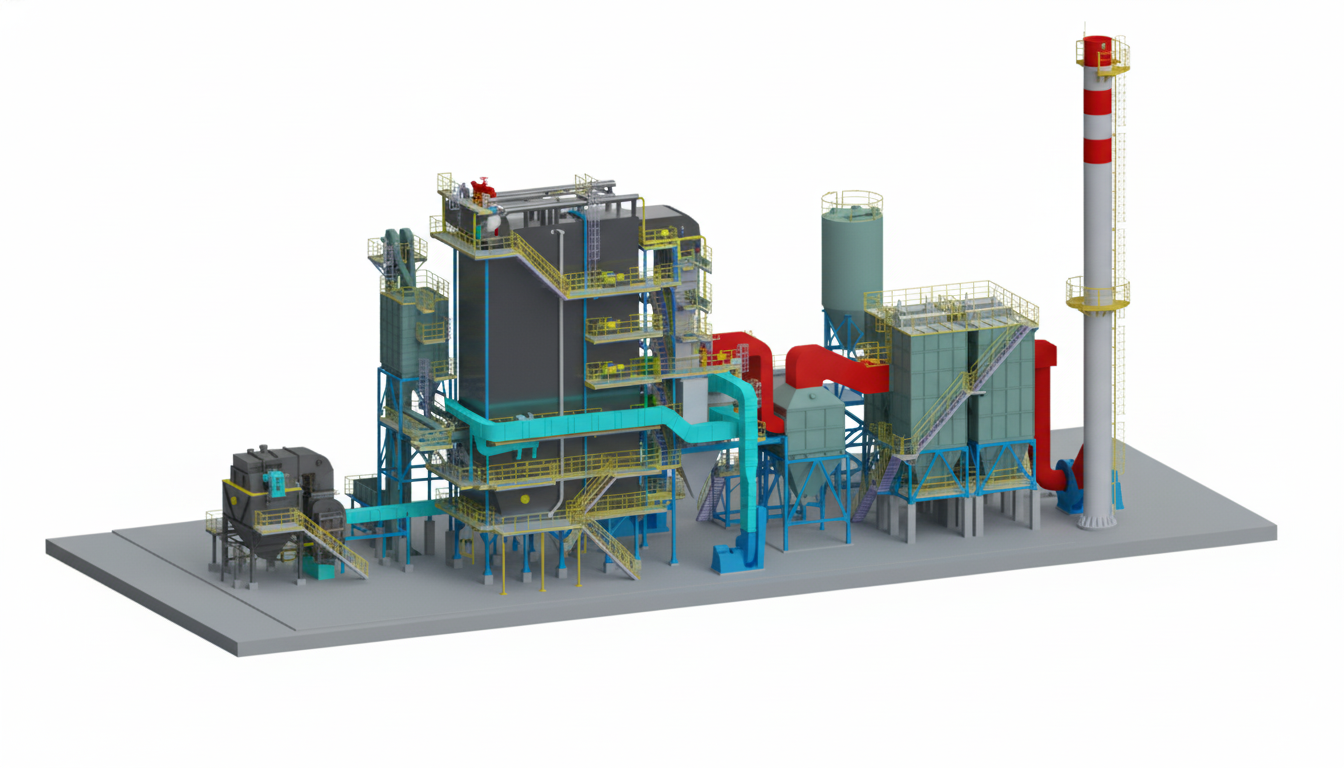
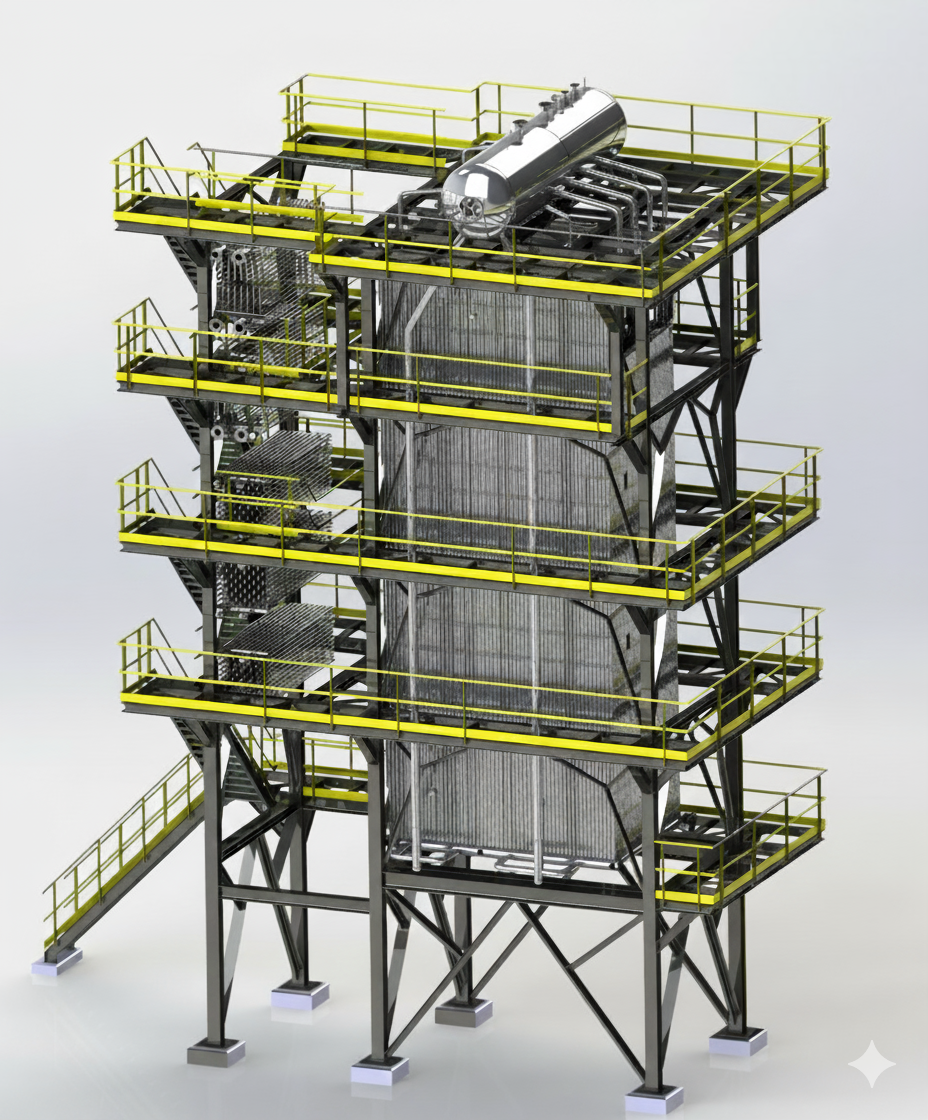
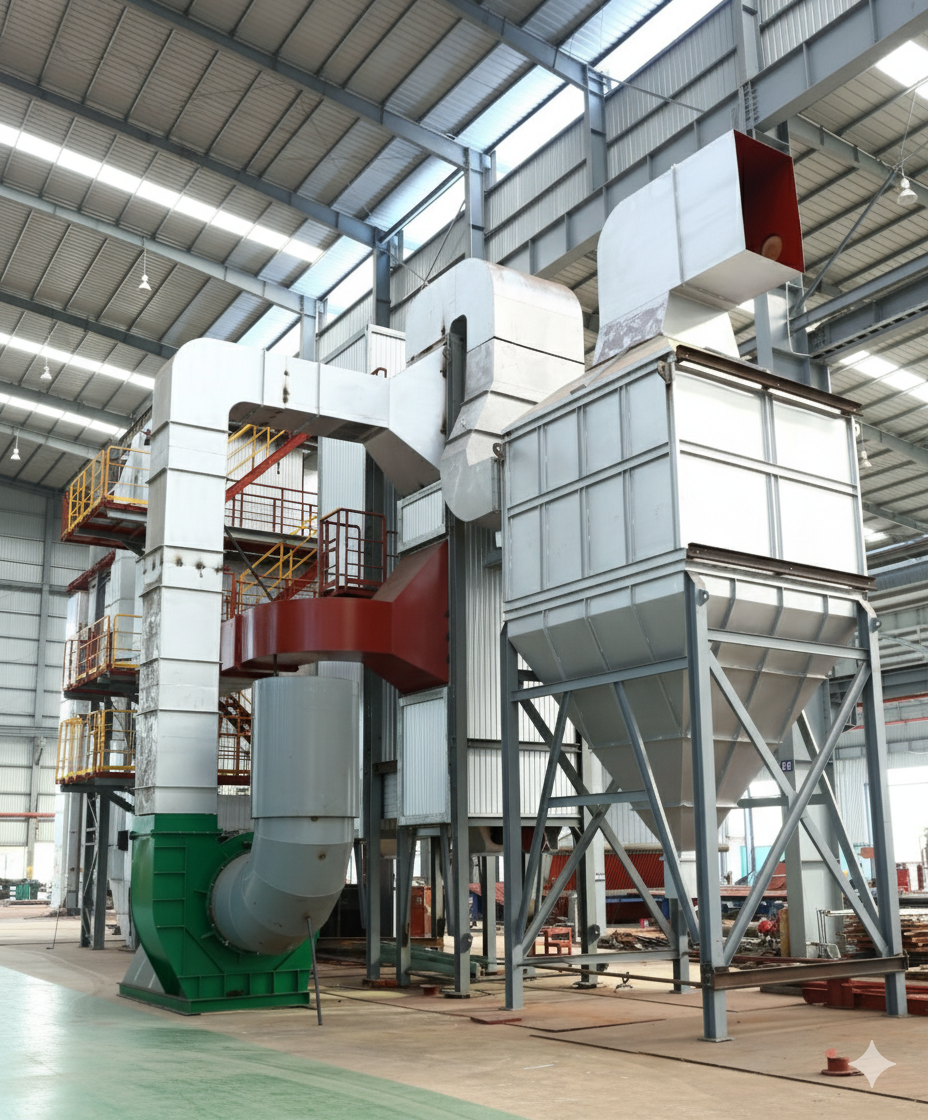
NEO MAKİNA ve MÜHENDİSLİK A.Ş. designs and installs turnkey fluidized bed boiler systems (NEO-THERM™) that burn difficult fuels such as low-grade lignite, high-moisture biomass, sewage sludge and RDF efficiently and with low emissions. Bubbling (BFB) and circulating (CFB) configurations are selected according to plant capacity.
What Is a Fluidized Bed Boiler?
In a fluidized bed boiler, fuel is burned inside a hot bed of sand/ash kept in suspension by air blown from below. Bed temperature is held at 800–900 °C; the intense solid-gas mixing gives high heat transfer and complete combustion. This principle allows fuels with variable calorific value and moisture to be burned stably.
Three Core Advantages
- Fuel flexibility: Coal, biomass, pellets, sewage sludge and process waste can be burned in the same boiler and switched according to supply and price.
- Emission control at source: Limestone dosed into the furnace captures SO₂ in the bed; the low combustion temperature around 850 °C and staged air limit NOx formation. In most applications no separate FGD/SCR unit is required.
- High combustion efficiency: Long residence time and recirculated particle flow keep unburned carbon in ash low; with economiser and air preheater, boiler efficiency exceeds 90%.
BFB and CFB Configurations
Bubbling Fluidized Bed (BFB)
Suited to medium-capacity steam and hot-water generation. Low fluidization velocity, simple bed structure and lower investment cost make it the preferred choice for biomass and sludge firing plants.
Circulating Fluidized Bed (CFB)
- Hot cyclone separators: Unburned particles and limestone leaving the furnace are separated by centrifugal force and returned to the bed.
- Loop seal: Solids collected below the cyclone return to the combustion chamber through a pneumatic siphon that prevents back-flow; a carbon particle stays in the loop until fully burned.
- Refractory and erosion protection: Cyclone interiors and the lower furnace are lined with high-alumina, SiC-reinforced refractory resistant to abrasion and thermal shock.
Combustion Physics and Operating Performance
- Heat transfer coefficient: Continuous particle contact gives in-bed tubes heat transfer several times higher than conventional gas-solid systems.
- Thermal inertia: The large hot bed mass holds temperature through sudden changes in fuel moisture or calorific value, eliminating flame-out risk.
- Turndown: Stable operation from 30% to 100% load by proportionally reducing fluidization air and fuel feed.
Emission Control Mechanisms
In-furnace desulfurization
When high-sulfur lignite or petcoke is fired, pulverised limestone is fed into the furnace. The Ca/S molar ratio is controlled automatically; sulfur leaves the system with the bottom ash as gypsum (CaSO₄) rather than in the flue gas.
Staged combustion and DeNOx
A bed temperature around 850 °C limits thermal NOx. Combustion air is split into primary (bed) and secondary (upper furnace); the bed zone is kept sub-stoichiometric to suppress fuel NOx.
Typical Application Range
- Steam capacity: 10 – 150 t/h (BFB medium, CFB high capacity)
- Pressure / temperature: saturated up to 40 bar or superheated up to 450 °C; higher on a project basis
- Fuel: lignite, hard coal, petcoke, biomass (up to 50% moisture), sewage sludge, RDF
- Design codes: ASME Section I / EN 12952; CE conformity
The NEO MAKİNA Difference
Every project is engineered from fuel analysis and load profile with combustion, bed hydrodynamics and emission calculations. BFB/CFB selection, cyclone and refractory design, limestone dosing and automation are delivered from a single source. Commissioning, operator training and spare-parts support are covered by NEO MAKİNA.
Frequently Asked Questions
Which fuels suit a fluidized bed boiler?
It is the most suitable technology for low-calorific, high-moisture fuels: lignite, biomass, sewage sludge, agricultural residues and RDF. Fuel blends can be fired in the same boiler.
BFB or CFB?
BFB for medium capacity and lower investment; CFB for high capacity, high-sulfur fuels and strict emission limits. The choice is made at proposal stage from fuel analysis and capacity.
Is a flue-gas treatment unit required?
Limestone dosing and staged combustion meet most SO₂ and NOx limits; a bag filter or electrostatic precipitator for particulates is standard scope.
To select the right fluidized bed configuration for your fuel and request a quotation, contact us.