
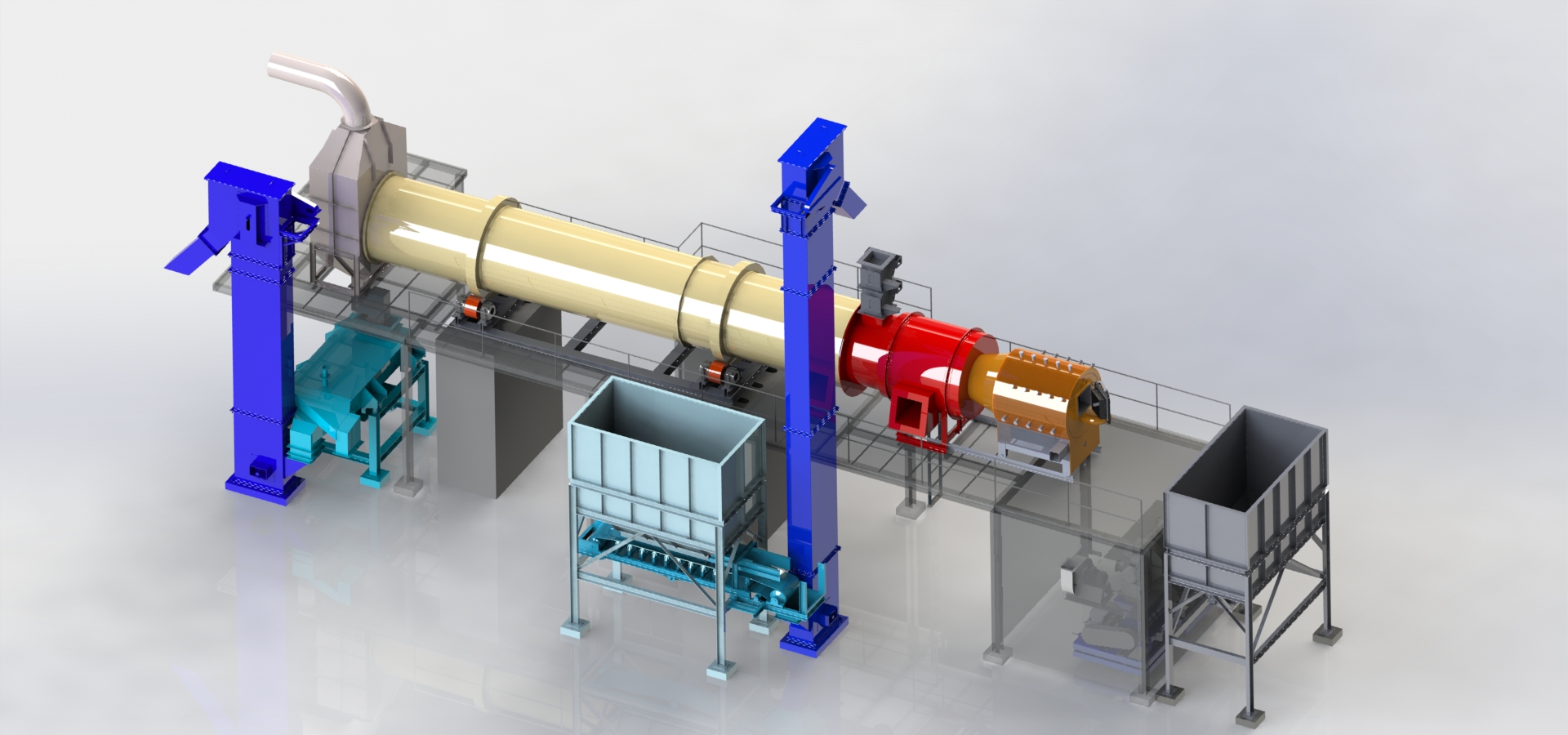
NEO MAKİNA ve MÜHENDİSLİK A.Ş. designs and installs industrial dryer (rotary drum drying) systems for high-capacity drying of bulk solids, biomass, minerals and industrial by-products. Direct-heated (convective) and indirect-heated (conductive) drum dryers handle sand, lime, coal, wood chips, beet pulp, DDGS, fertiliser and sludge with water-evaporation capacities from 1 to 80 t/h and integrate with waste-heat sources. Our references include a 2×15 t/h lime drying project in Herat and a 100 t/h beet-pulp drying plant.
How Does a Rotary Drum Dryer Work?
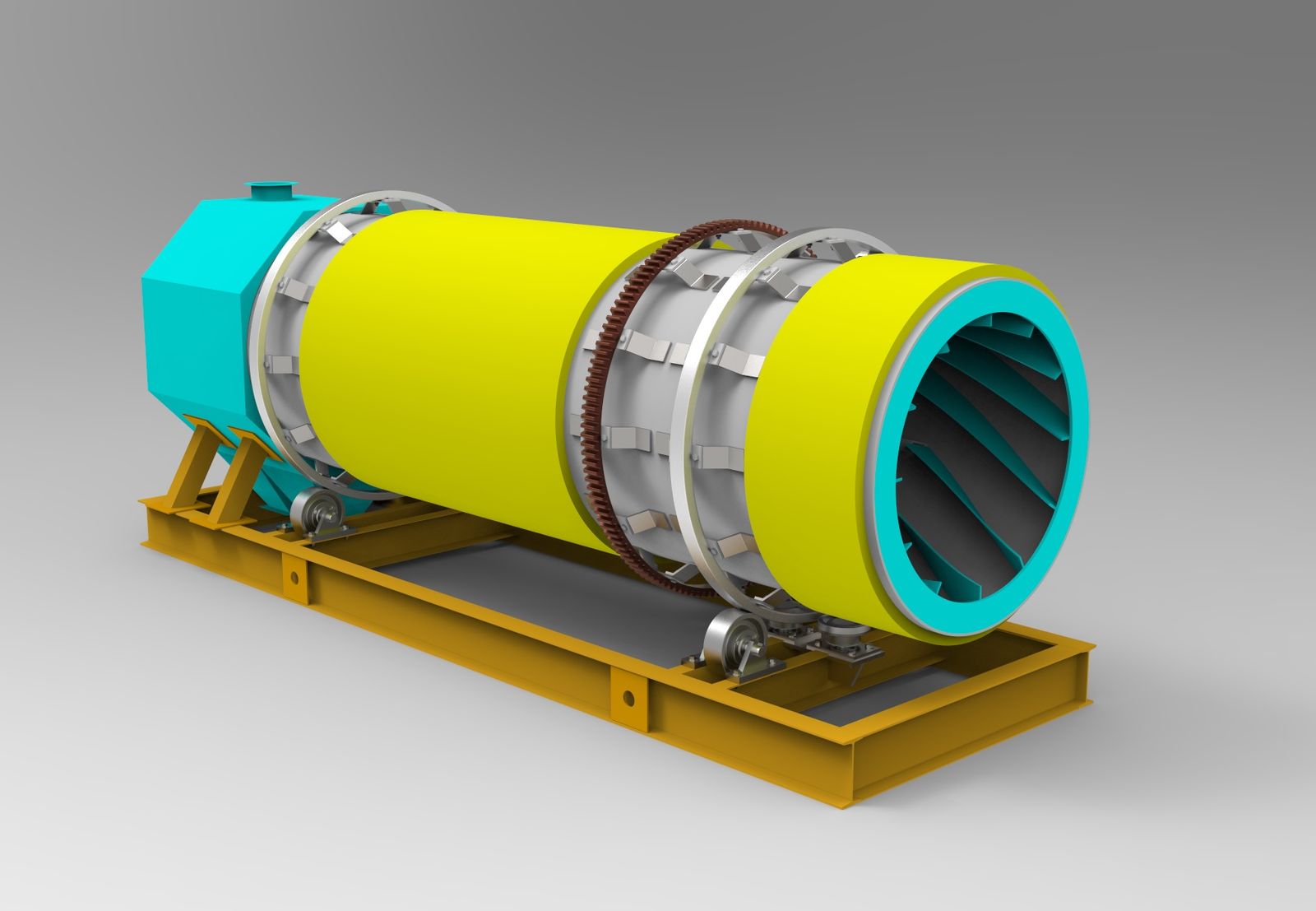
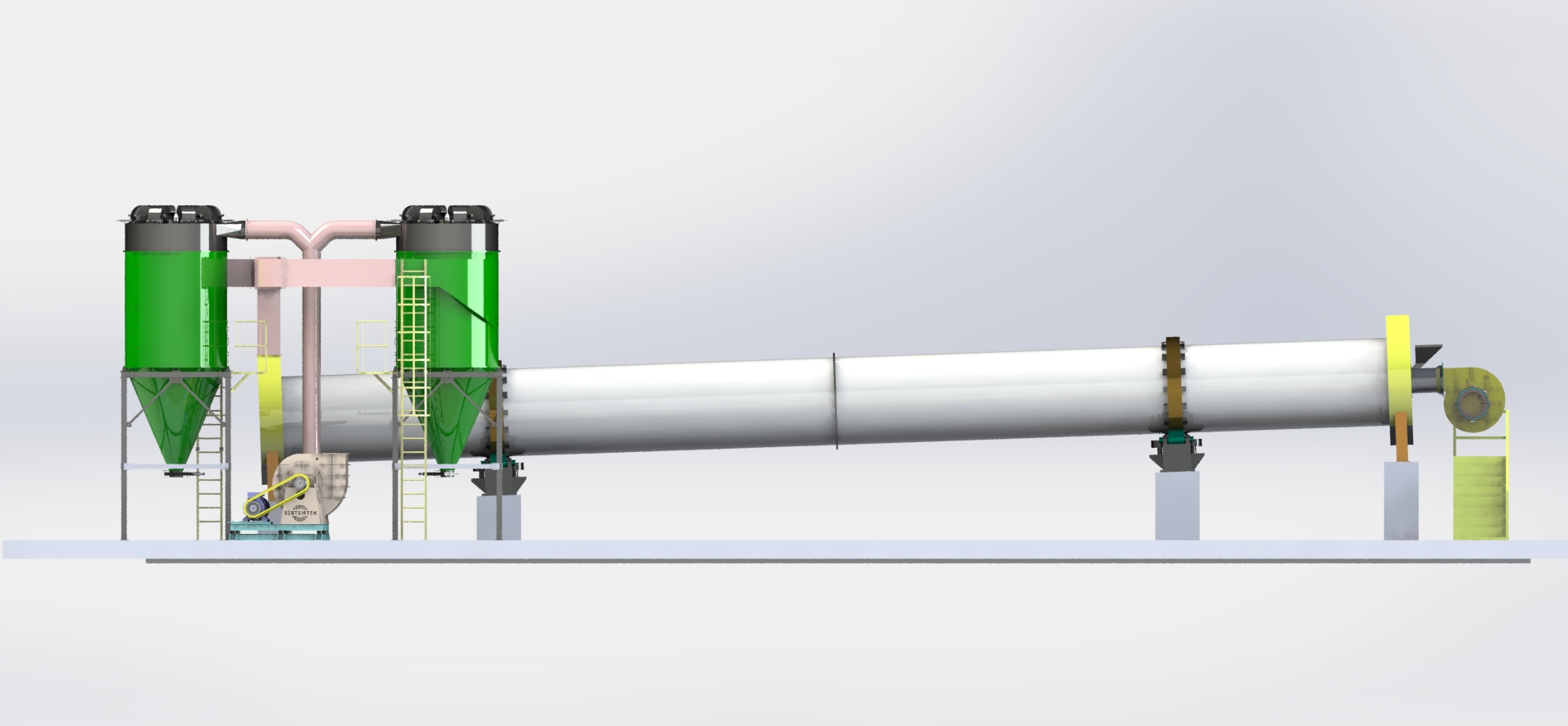
Lifting flights inside a slightly inclined, slowly rotating (2–8 rpm) cylindrical drum lift the material and cascade it as a curtain through the hot gas stream; the product loses moisture as it travels along the drum. Gas flow can be co-current (heat-sensitive products) or counter-current (low final moisture). At the outlet, cyclone and filter capture dust; dried product goes to a cooler or screen.
Dryer Types
Direct-Heated Drum Dryers (Convective)
- Principle: Burner hot gas or waste flue gas contacts the product directly; high heat-transfer coefficient, large capacity.
- Materials: Wood chips and sawdust (before pelleting), beet pulp, DDGS, olive pomace, sand and aggregate, limestone, coal, fertiliser, clay, slag, sewage sludge.
- Heat source: Natural gas, LPG, fuel oil or biomass burner; direct feed of gas-turbine/engine exhaust or boiler flue gas (higher exergy efficiency).
- Capacity: 1 – 80 t/h water evaporation; drum diameter 1 – 5 m, length 6 – 35 m.
- Options: Compact triple-pass drum, flash-dryer pre-stage for very wet feed, back-mixing, cyclone and drop-box separators.
Indirect-Heated Drum Dryers (Conductive)
- Principle: Heat is conducted through a steam/thermal-oil jacket or in-drum tube bundle; the product never contacts combustion gas.
- Materials: Fine, valuable or contamination-sensitive products; chemicals, mineral powders, food by-products, products with explosion risk.
- Advantage: Low exhaust-gas flow and small filter; full integration with cogeneration waste heat; low emissions.
- Capacity: 0.5 – 10 t/h water evaporation; higher in steam-tube versions.
System Components
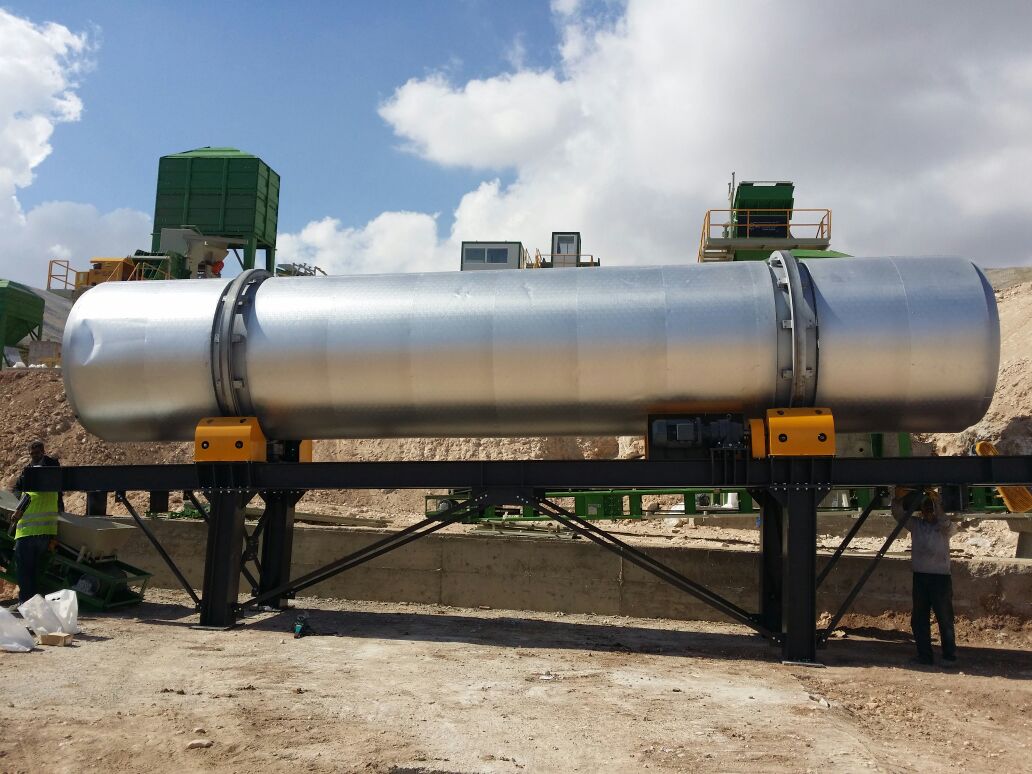
- Drum: S355 / P265GH steel shell, heat-resistant steel inlet section, riding rings and support rollers, thrust rollers.
- Lifting flights: Flight geometry designed for the product; wear-plated or stainless versions.
- Drive: Girth gear-pinion or chain drive, variable-speed gear motor.
- Combustion chamber and burner: Refractory-lined furnace, modulating burner, EN 746-2 compliant gas train; mixing chamber for waste-gas inlet.
- Gas cleaning: Multicyclone, bag filter or wet scrubber; biofilter or thermal oxidiser option for odour.
- Automation: Burner and feed control from outlet product moisture and gas temperature; CO/temperature monitoring, fire-suppression system (biomass), SCADA.
Typical Application Range
- Water evaporation: 1 – 80 t/h; product throughput 2 – 200 t/h
- Inlet moisture: up to 80% (with dewatering/flash pre-drying); outlet moisture: 0.5 – 15%
- Gas inlet temperature: 250 – 900 °C (by product)
- Sectors: biomass and pellet plants, sugar factories (beet pulp), ethanol (DDGS), olive oil (pomace), mining and aggregates, lime and cement, fertiliser, sewage sludge
- Standards: CE Machinery Directive, EN 746-2 / NFPA 86, ATEX (dust), national industrial air-pollution regulation
Assessment: Advantages and Points to Consider
- Advantage: Low specific energy cost through integration with existing waste-heat sources (turbine/engine exhaust, boiler flue gas); economies of scale and short payback at high capacity; robust construction for 24/7 operation.
- Consider: In direct heating, gas temperature and residence time must be controlled against thermal degradation and ignition; large drums need space and foundations designed for dynamic loads.
Why NEO MAKİNA?
The dryer is sized from material moisture analysis, drying kinetics and mass-energy balance. It is installed turnkey including burner/waste-heat integration, gas cleaning and automation; heat recovery and dust collection units are engineered by the same team. For food products see conveyor drying systems.
Frequently Asked Questions
Direct or indirect heating?
Direct heating is more economical for heat-tolerant bulk material at high capacity; indirect heating is preferred for fine, valuable products where contamination is unacceptable or when cogeneration steam is available.
How much energy is needed to evaporate 1 tonne of water?
Typical specific consumption in a direct-heated drum is 800–1,100 kWh (2.9–4.0 GJ) per tonne of water; it is reduced with waste-heat use and exhaust recirculation.
How is fire risk managed when drying beet pulp or wood chips?
Gas inlet temperature limits, CO and temperature monitoring, spark detectors, automatic water spray and emergency shutdown procedures keep the risk under control.
For dryer design, energy balance and a quotation based on your product and capacity, contact us.