
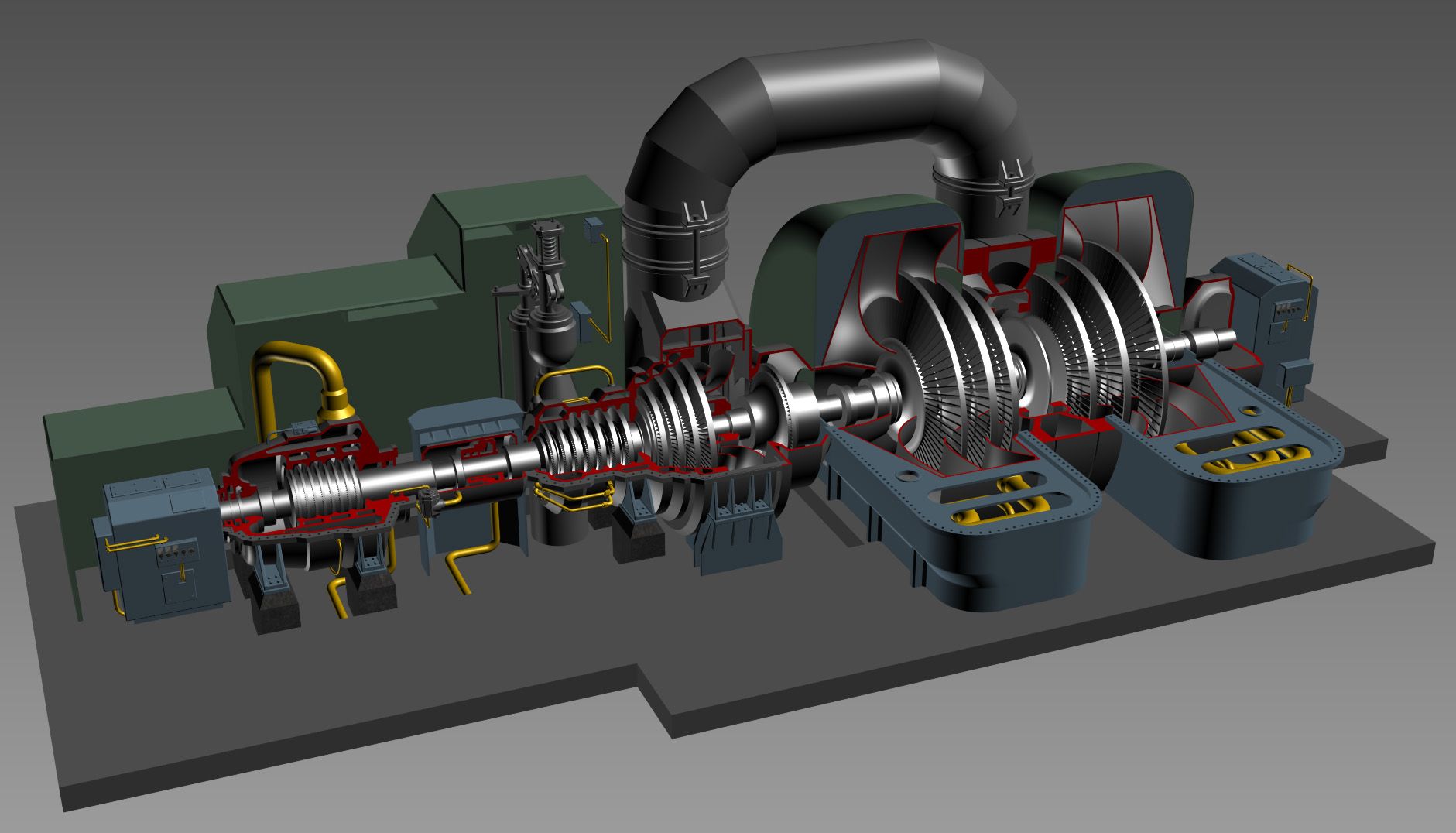
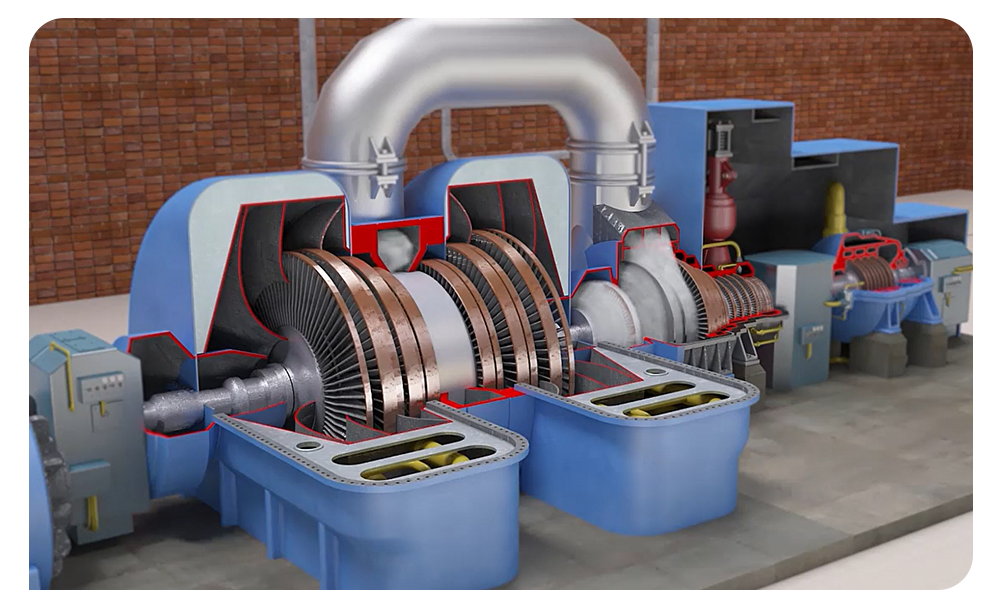
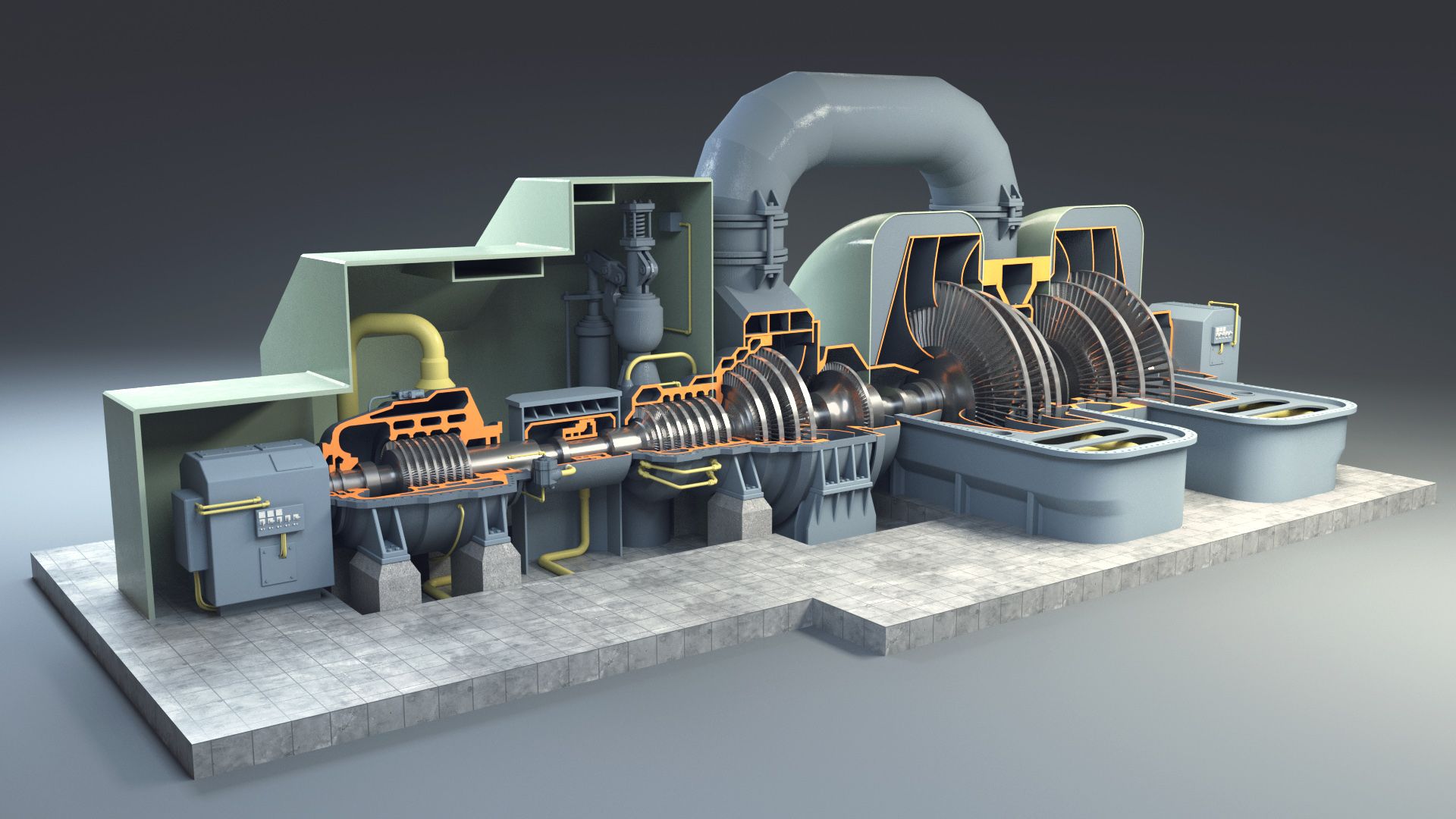
NEO MAKİNA ve MÜHENDİSLİK A.Ş. provides engineering, supply and turnkey installation of industrial and utility steam turbines (NEO-STEAM™) and turbine-generator sets for power plants and large industrial sites. Turbine trains of high-pressure (HP), intermediate-pressure (IP) and low-pressure (LP) stages are designed for base-load power generation in coal, biomass, geothermal and waste-heat plants.
Steam Turbine Types
High-Pressure (HP) Turbines
- Steam conditions: 40–140 bar, 400–540 °C superheated steam; higher parameters on a project basis.
- Blading: Impulse or reaction type with 3D aerodynamic blade profiles.
- Casing: Double-shell cast steel casing resistant to thermal stress.
- Duty: Prime mover driving the generator; high-voltage power to the grid.
Intermediate (IP) and Low-Pressure (LP) Turbines
- Cycle completion: Energy of HP exhaust steam is used down to the last stage to raise cycle efficiency.
- Waste heat recovery (WHR): Power generation from steam raised on cement, glass and steel processes or gas-turbine exhaust.
- Cogeneration (CHP): Extraction steam for process or district heating; total energy utilisation 85–90%.
- Condenser integration: Last-stage blades designed for vacuum operation and high-volume exhaust flow to the condenser.
Power Plant Solutions (EPC)
- Fuel flexibility: Turbine-boiler-condenser integration for coal and lignite plants, biomass and waste-to-energy plants, geothermal and waste-heat plants.
- Base-load operation: High moment of inertia and stable rotor dynamics for 24/7 running.
- Grid support services: Frequency control, fast ramp-up/ramp-down and island-mode operation.
- Scope: Heat-balance calculation, turbine selection, generator, condenser, cooling tower, lubrication and control systems, erection and commissioning.
Design and Quality Principles
- Rotor: Monoblock forged rotor optimised by finite element analysis (FEA) and precision-balanced to ISO 1940-1 to minimise vibration risk.
- Metallurgy: High-alloy steels and coated blades for creep resistance at high temperature; long economic life.
- Monitoring and control (NEO-Control™): Continuous monitoring of vibration, bearing temperature and axial displacement; predictive-maintenance algorithms warn of faults in advance.
- Standards: API 611/612, IEC 60045-1, ASME PTC 6 (performance testing).
Typical Application Range
- Output: 5 – 150 MW (single unit); for smaller industrial turbines see Steam Turbines
- Speed: 3000/3600 rpm direct drive or geared
- Types: condensing, back-pressure, extraction-condensing
- Applications: thermal power plants, biomass plants, waste-to-energy, geothermal, industrial cogeneration
After-Sales and MRO Services
- Erection and commissioning supervision.
- Planned overhaul and outage management.
- On-site machining and OEM spare-parts support.
Frequently Asked Questions
What is the difference between condensing and back-pressure turbines?
A condensing turbine expands steam down to vacuum for maximum electricity. A back-pressure turbine exhausts at process pressure; less electricity, but higher total energy efficiency.
How much electricity can be generated from waste heat?
As an example, 4–8 MW from a 3,000 t/day clinker cement line; the figure depends on flue-gas temperature and flow. A preliminary calculation is made from process data at proposal stage.
What is the delivery time?
Typical manufacturing time for a turbine-generator set is 10–16 months; total EPC duration is 18–30 months.
For turbine selection, heat-balance calculation and a quotation for your plant, contact us.