
NEO MAKİNA ve MÜHENDİSLİK A.Ş. designs and manufactures cabinet-type static drying systems (drying ovens) for batch production, wide product ranges and R&D applications. Tray-trolley cabinet dryers, large car-bottom ovens and hanging cabinets secure product quality with uniform temperature and controlled moisture extraction in fruit-vegetable, herb, meat and fish, ceramic, composite, paint-curing and solvent-evaporation processes.
What Is a Cabinet Dryer?
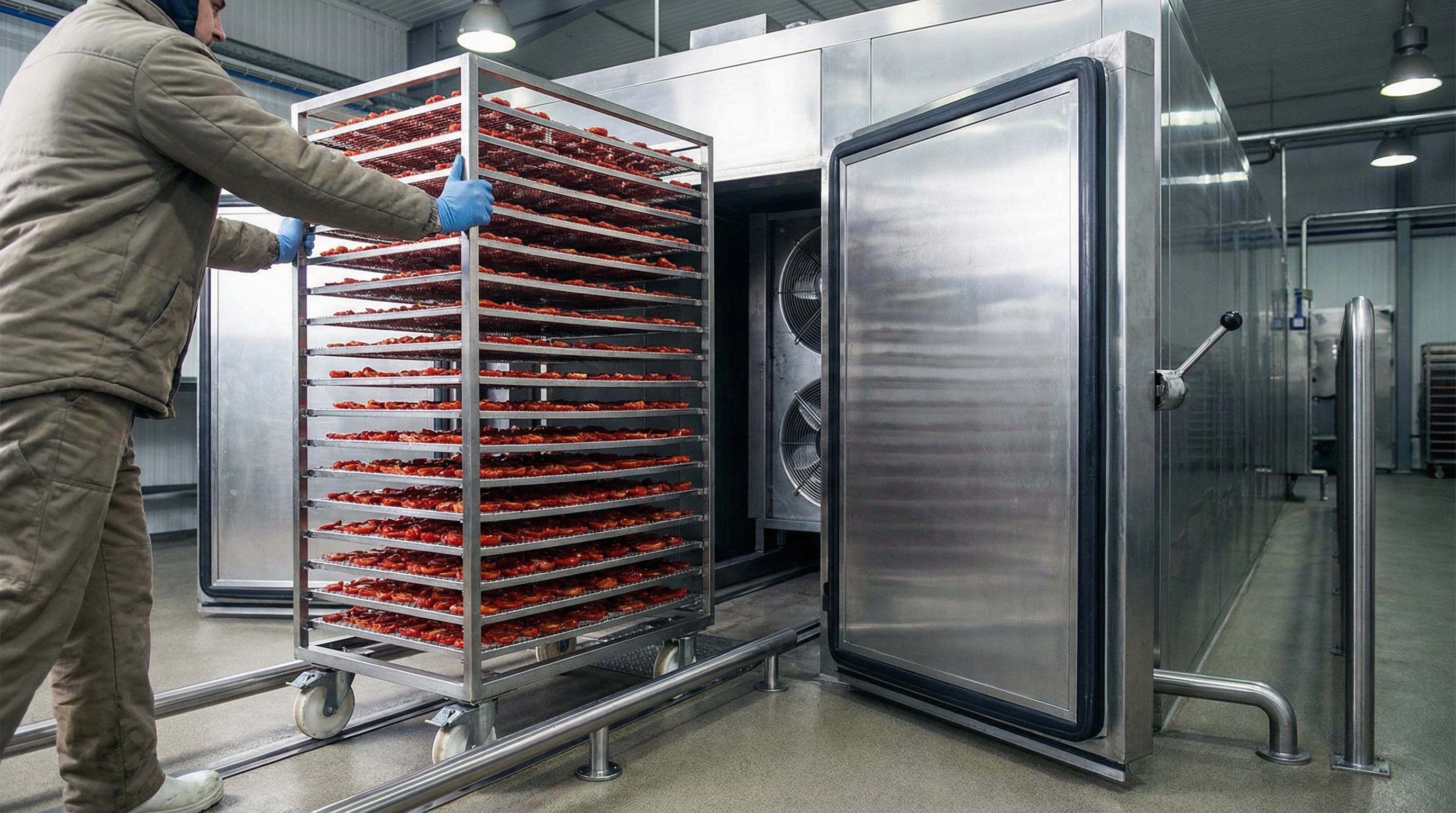
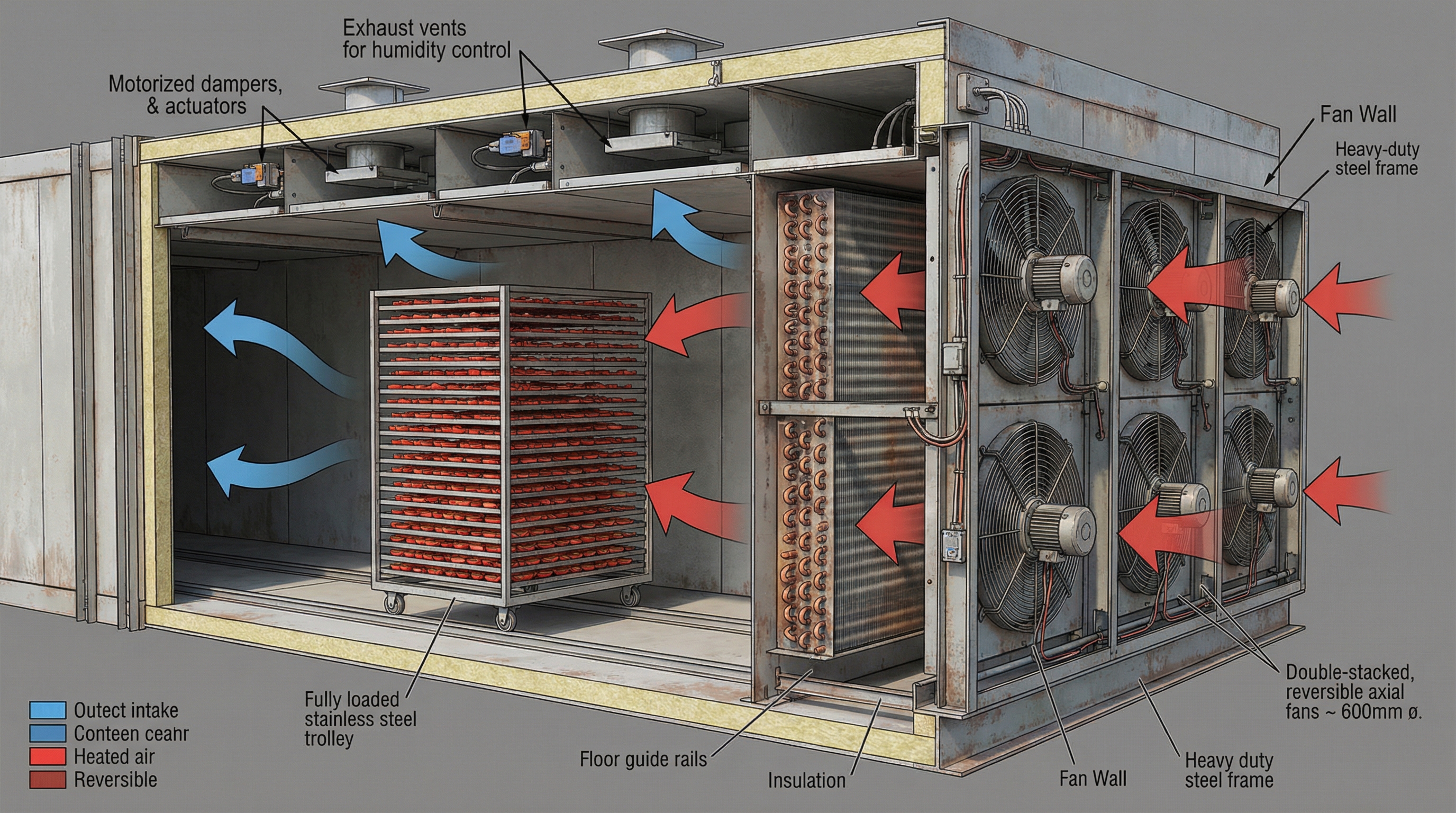
In a cabinet (static) dryer the product is loaded on trays or hangers on trolleys into an insulated closed cabinet; heated air is circulated over the product by fans and part of the humid air is exhausted through dampers. The product stays stationary throughout drying; when the recipe is complete the trolley is removed. It is the most flexible solution for small-medium capacity, frequent product changes and sensitive products.
Design Elements
Airflow Management
- Horizontal cross-flow: Air passes horizontally between trays; periodic flow reversal reduces front-to-back temperature difference to ±2 °C.
- Vertical flow: Air passes through the product layer on perforated trays; fast drying of granular and sliced products.
- Combined flow with baffles: CFD-verified air distribution ducts; uniform velocity and temperature across the cabinet volume.
Humidity and Temperature Control
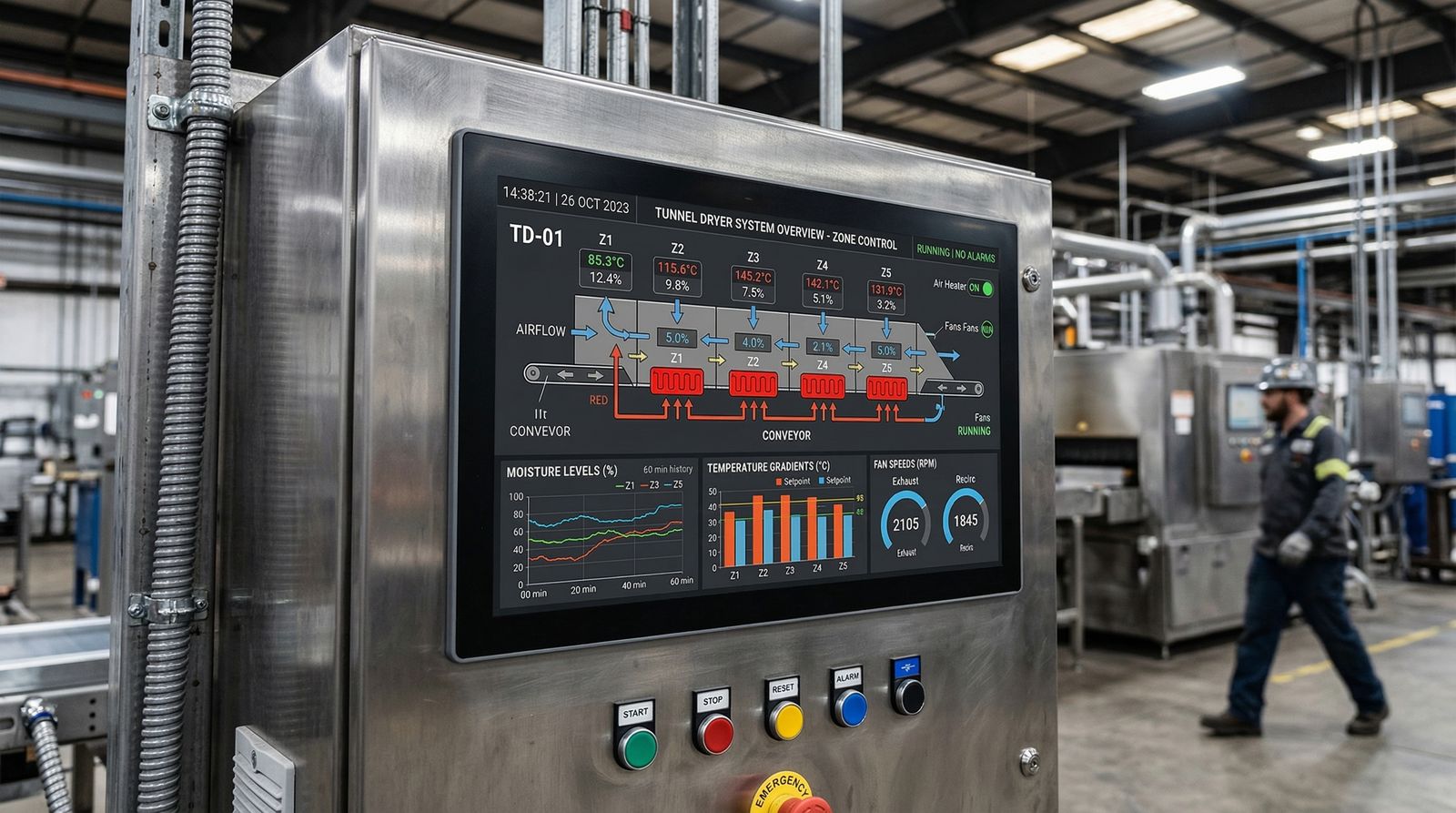
- Motorised fresh-air/exhaust dampers and relative-humidity sensors for staged moisture extraction; case hardening prevented.
- Multi-step recipes: preheating, constant-rate drying, falling-rate drying, cooling; product core-temperature probe option.
- Heat-pump low-temperature (35–60 °C) version for aroma and colour retention and low energy consumption.
Housing and Insulation
- Cassette-type sandwich panels; 80–150 mm high-density rock wool or ceramic fibre; thermal-bridge-free design.
- Interior AISI 304 stainless (food) or galvanised/painted sheet (industrial); washable floor and drainage.
- Double-leaf doors, viewing window, trolley rails and ramps.
Heat Source
- Steam or hot-water coil, thermal oil, natural gas/LPG indirect (heat exchanger) or direct burner, electric heaters, heat pump, biomass hot-air generator.
- Gas train and burner safety to EN 746-2 / NFPA 86.
Loading and Safety Configurations
- Tray trolleys: 1 – 20 trolleys, 20–60 trays each; food, herbs, ceramics and small parts.
- Car-bottom ovens: Heavy and large parts, loads above 50 tonnes; composites, castings and paint curing.
- Hanging cabinets: Sausage, cured meat, fish, pasta and textile products.
- Special atmospheres: ATEX/Ex-proof design, explosion venting and LEL monitoring for solvent evaporation; inert (N₂) atmosphere option.
Typical Application Range
- Capacity: 100 kg – 20 t fresh product per batch (by cabinet size)
- Operating temperature: 35 – 250 °C (up to 350 °C in curing ovens)
- Temperature uniformity: ±2–3 °C across the load
- Applications: dried fruit and vegetables, spices and herbs, meat and fish products, pasta, nuts, ceramic and refractory pre-drying, paint and composite curing, wood, leather
- Standards: CE Machinery Directive, EN 746-2 / NFPA 86 (heating and gas train), ATEX 2014/34/EU, EN 1672-2 (food hygiene)
Why NEO MAKİNA?
- Product-specific recipe: Drying kinetics established by laboratory trial; cabinet size, air velocity and heat capacity calculated accordingly.
- Uniformity: CFD-assisted duct design and reversing airflow give the same drying on every tray.
- Energy efficiency: Exhaust recuperation, heat pump and variable-speed fans for low operating cost.
- Scalability: Capacity grows by adding cabinets; for the move to continuous production see conveyor drying and industrial dryer solutions.
Frequently Asked Questions
Cabinet or conveyor dryer?
Cabinet type for under 2–3 tonnes of fresh product per day, wide product variety and frequent recipe changes; conveyor dryers are more economical for single products at high capacity.
How long does drying take?
Product-dependent: sliced apple 8–12 h, apricot 18–30 h, spices and herbs 4–8 h, paint curing 30–90 min. Confirmed by recipe trial.
Does a heat-pump dryer save energy?
Yes. At 40–60 °C it uses 0.3–0.5 kWh per kg of water evaporated, 50–70% less than conventional electric dryers; a hybrid solution is applied for processes needing higher temperatures.
For cabinet dryer design, trial drying and a quotation for your product, contact us.