
NEO MAKİNA ve MÜHENDİSLİK A.Ş. engineers and delivers turnkey ORC (Organic Rankine Cycle) power plants as skid-mounted modular units that generate electricity from waste heat, geothermal and biomass sources in the 90–300 °C range. Operating water-free and unattended at temperatures where steam turbines are inefficient, ORC systems turn waste heat into revenue in cement, steel, glass, geothermal and biogas plants.
How Does ORC Work?
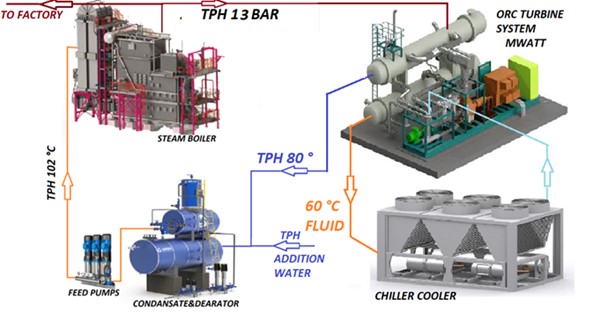
ORC follows the same thermodynamic principle as the steam cycle; the difference is a low-boiling organic working fluid instead of water.
- Evaporator: Hot gas, water or thermal oil passes through the heat exchanger; the organic fluid evaporates at 80–150 °C and builds pressure.
- Turbine / expander: Pressurised organic vapour drives a radial or axial turbine; the coupled generator produces electricity.
- Condenser: Turbine exhaust vapour condenses in an air- or water-cooled condenser.
- Circulation pump: Liquid fluid is pumped back to the evaporator; the closed loop provides continuous generation.
Applications and Heat Sources
- Cement and lime: Rotary-kiln flue gas and clinker-cooler air (250–400 °C).
- Steel and glass: Flue gases from arc furnaces, annealing and melting furnaces.
- Geothermal: 90–150 °C low/medium-enthalpy well fluids (binary cycle).
- Biomass and biogas: Biomass-boiler thermal oil; biogas-engine exhaust and jacket-water heat.
- Engine and gas-turbine exhaust: Bottoming-cycle applications on diesel gensets and gas turbines.
Technical Architecture
Turbo-generator
- Radial-inflow turbine: CFD-optimised blading; 85–90% isentropic efficiency, tolerant of variable flow.
- Screw expander: Robust, low-speed option for low-pressure, fluctuating sources needing wet-vapour tolerance (geothermal).
- Bearings and sealing: Oil-lubricated or magnetic bearing option; hermetic housing or mechanical seal with zero fluid leakage.
Working Fluid
- Selected for source temperature: R245fa, R134a or 4th-generation HFOs (R1233zd(E), R1234ze; ODP = 0, GWP < 1).
- Non-toxic, non-flammable (class A1) fluids; plant safety without ATEX zoning.
Heat Exchangers and Condenser
- TEMA shell-and-tube or compact brazed-plate evaporators sized by pinch-point analysis.
- Air-cooled condenser with inverter-controlled EC fans; adiabatic pre-cooling for hot climates; water-cooled option.
Electrical and Automation
- Synchronous or induction generator (IP54); LV (400 V) or MV (6.3–34.5 kV) connection with grid-code-compliant protection relays.
- Island-mode option; automatic part-load optimisation, remote monitoring.
Skid-Mounted Modular Design
- Turbine, generator, pump and panels factory-assembled on a single steel skid or in an ISO container.
- Piping (ASME B31.3), pressure tests and FAT completed in the factory; site installation takes days.
Typical Application Range
- Electrical output: 100 kWe – 5 MWe per module; higher with parallel modules
- Heat-source temperature: 90 – 300 °C (up to 350 °C with thermal oil)
- Net electrical efficiency: 8–20% depending on source temperature
- Standards: PED 2014/68/EU, ASME B31.3, IEC 60034, CE
Operating Advantages
- Electricity from low-grade heat: Heat otherwise vented or cooled at a cost becomes revenue.
- No water consumption: Closed loop; no blowdown, water treatment or chemicals.
- Autonomous operation: Detects changes in the heat source and moves to part load automatically; no 24/7 operator.
- Long life: Dry-vapour expansion means no blade erosion; low speed and pressure give 20+ year life and low maintenance.
- Additional income: Carbon-reduction certificate potential (VCS/Gold Standard) on top of electricity savings.
Frequently Asked Questions
What is the minimum heat source for ORC?
Economic application usually needs at least 1–2 MWt of continuous heat above 90 °C. For example, 10 t/h of flue gas at 250 °C can yield roughly 150–250 kWe.
ORC or steam turbine?
Below 300 °C and 5 MWe, ORC offers higher efficiency, lower maintenance and water-free operation. For high temperatures and large capacities, steam turbines are preferred.
What is the payback period?
Typically 3–6 years depending on heat-source continuity and electricity price; a feasibility study is prepared from process data at proposal stage.
To find out how much electricity your waste-heat source can generate and request a quotation, contact us.